

 🇪🇺
🇪🇺










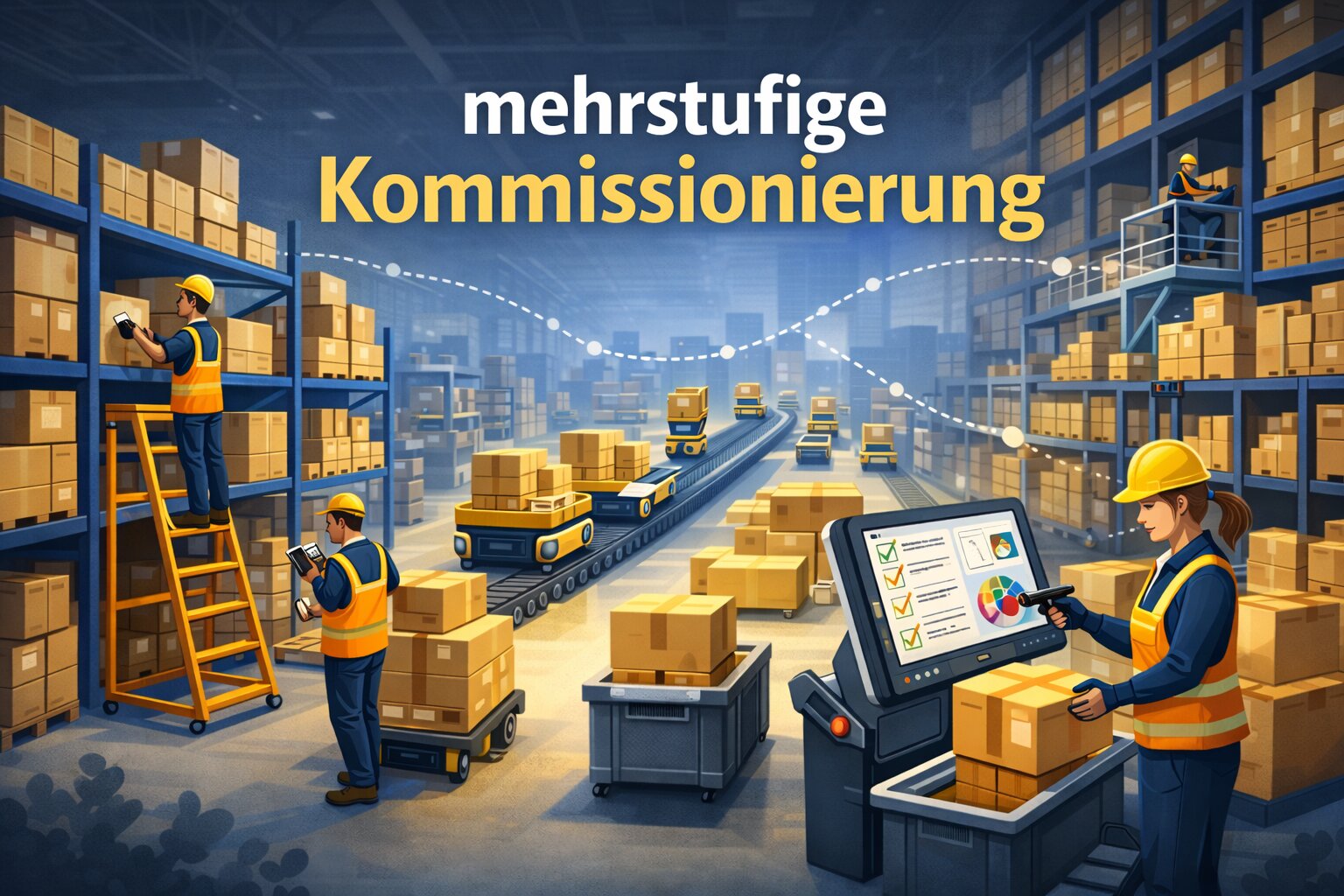
Those who process many orders per day quickly reach their limits with classic single-order processing. This guide shows how you can shorten travel distances and increase throughput through intelligent bundling of orders.
What is multi-stage picking and when is it worthwhile?
Multi-stage picking is one of the most efficient methods in modern warehouse logistics. Instead of guiding each customer order individually through the warehouse, this approach bundles multiple orders and processes them in coordinated work steps. At Futura Marketing, we have relied on well-thought-out picking processes since 1993, ensuring a consistently low error rate even with high order volumes. In this article, we explain how multi-stage picking works, which methods exist, and for which warehouse size the switch is worthwhile.
What does multi-stage picking mean in logistics?
Distinction from single-stage picking
With single-stage picking, each customer order is processed individually. An employee receives an order, walks through the warehouse, collects all required items, and then packs the shipment directly. This method is easy to implement, requires no complex planning, and is well suited for small warehouses with few orders per day.
Multi-stage picking follows a different approach. Here, multiple orders are combined into a single batch order. The employee collects the items for all bundled orders in one pass and then sorts them into the individual orders. This significantly reduces travel distances in the warehouse.
Typical process in two or more stages
The process is divided into at least two phases. In the first stage, the collection phase, all required items for multiple orders are removed from the shelves in an item-oriented manner. The picker follows an optimized route through the warehouse instead of traversing the same aisles individually for each order.
In the second stage, the distribution phase, the collected items are assigned to the respective customer orders at a sorting station and packed. For particularly large warehouses or complex product ranges, a third stage may be added, such as a quality check or a consolidation of partial shipments from different warehouse areas. Order assembly and picking are closely interlinked.
Single-stage and multi-stage picking in comparison
Single-stage picking and its limits
The single-stage method has a clear advantage in its simplicity. There is no sorting effort, no batch planning, and no additional space required for sorting stations. For warehouses with fewer than 50 orders per day and a manageable product range, it is usually entirely sufficient.
However, beyond a certain order volume, single-stage picking reaches its limits. Travel distances increase linearly with the number of orders, since the employee covers the same path through the warehouse for each order. At 200 or more orders per day, the kilometers covered add up considerably and slow down the entire shipping process.
Advantages of multi-stage order processing
Single-stage and multi-stage picking differ fundamentally in efficiency and scalability. The following table provides an overview of the most important differences
| Feature | Single-stage | Multi-stage |
|---|---|---|
| Travel distances | High, each order individually | Significantly reduced through batching |
| Error rate | Low at small volume | Low due to standardized processes |
| Throughput per hour | Limited by individual processing | 30 to 50% higher with the same staff |
| Scalability | Limited | High, even during seasonal peaks |
| Planning effort | Low | Medium to high |
| IT requirement | Low | WMS recommended |
From an order volume of 100 to 200 orders per day, the additional planning effort of the multi-stage method typically pays for itself within a few weeks. The decisive lever lies in the reduction of travel distances, which can decrease by 30 to 50% with well-planned batch sizes.
What methods exist in multi-stage order picking?
Batch Picking and Consolidated Order Picking
Batch picking is the most widely used method of multi-stage order picking. Multiple customer orders are combined into a batch (stack). The picker receives a consolidated pick list containing all required items for the entire batch and collects them in a single warehouse walk.
The collected items are then assigned to individual orders at a sorting station. The optimal batch size depends on the number of items per order and the warehouse size. In practice, batches of 10 to 30 orders have proven efficient. Larger batches save more travel distance but increase sorting effort.
Zone Picking and Zone Order Picking
In zone picking, the warehouse is divided into firmly defined zones. Each zone has its own employees who pick exclusively the items from their area. If an order contains items from multiple zones, the collection container is passed from zone to zone until all positions are complete.
This method is particularly suitable for large warehouses with a broad product range. Employees know their zone precisely and can locate items more quickly. Zone picking can also be combined with batch picking. In this case, an employee collects items for multiple orders simultaneously within their zone, which further increases efficiency.
Single-stage or two-stage order picking and which method fits
Small warehouses with a manageable product range
For warehouses under 500 sqm with fewer than 100 orders per day, single-stage versus two-stage order picking is not an either-or decision. In many cases, the single-stage method is sufficient. Travel distances are short, the overview is maintained, and the additional organizational effort of batch planning is not worthwhile.
An exception is warehouses with a very high variety of items and small orders. If each order contains only one to two items, even in a small warehouse a simple batch consolidation can noticeably increase throughput. In warehouse logistics, it therefore always depends on the individual circumstances.
Large logistics centers with high order volume
From a warehouse area of 1,000 sqm and more than 200 orders per day, there is hardly any way around multi-stage order picking. The travel distances in large warehouses are too long to process each order individually in an economically viable manner. This is where batch picking and zone picking unfold their full effect.
Particularly in e-commerce fulfillment with its typical pattern of many small orders and a broad product range, multi-stage methods are almost standard. The combination of optimized travel distances, parallel processing, and standardized sorting processes enables throughput increases of 30 to 50% compared to the single-stage method.
Advantages of multi-stage order picking for your company
Shorter travel distances and lower personnel costs
The most obvious advantage of multi-stage order picking lies in the reduction of travel distances. Instead of traversing the same aisles 20 times for 20 individual orders, the picker covers the distance only once. In a warehouse with 2,000 sqm of space and 300 orders per day, this can save several kilometers of travel distance per employee per shift.
This saving has a direct impact on personnel costs. Less travel distance means more picks per hour and thus fewer workers needed for the same order volume. Alternatively, the existing team can process significantly more orders with the same staffing level.
Higher throughput with increasing order volume
Multi-stage order picking scales better than the single-stage variant. When order volume increases, such as during the pre-Christmas period or during promotional periods, the batch size can simply be increased. Additional employees can be deployed at the sorting station without the entire warehouse organization having to be restructured.
The error rate also remains stable as volume increases. The clear separation of the collection and distribution phases makes errors at the sorting station easier to detect and correct. Standardized inspection steps between the stages act as an additional quality control and prevent incorrect items from ending up in the shipping packaging.
Challenges and typical errors during implementation
Planning effort and system requirements
Introducing multi-stage picking requires lead time and planning. You need a Warehouse Management System (WMS) that supports batch creation, route optimization, and sorting assignment. Without digital order control, the process can hardly be implemented error-free in practice.
In addition, you need space for a sorting station and, if necessary, sorting compartments or shelves in which the collected items are placed by order. The space requirement depends on the batch size. For batches with 20 orders, you should plan at least 10 to 15 sqm of sorting area.
Sources of error during sorting and distribution
The biggest source of error in multi-stage picking lies in the distribution phase. If items are assigned to the wrong order during sorting, an incorrect shipment results. Barcode scanners or pick-by-light systems at the sorting station significantly reduce this risk.
Another common error is an unfavorable batch size. Batches that are too small bring hardly any efficiency gain, while batches that are too large overload the sorting station and increase the risk of confusion. The optimal size can be determined through test runs with different order volumes. Based on our experience of more than 30 years, we recommend starting with small batches and adjusting the size gradually.
Multi-stage picking in everyday fulfillment operations
In daily fulfillment practice, the choice of picking method determines speed, quality, and costs. For products with many variants, such as fashion with different sizes and colors, the combination of zone picking and batch picking proves particularly effective. Food and supplements additionally require batch separation within the collection phase.
In picking, we consistently rely on the principle of zero-error tolerance. Every shipment is checked before dispatch, regardless of whether it was assembled in a single-stage or multi-stage process. Careful manual work and clear processes ensure that every order arrives correctly and completely with the recipient, even with a high order volume.
If you would like to optimize your picking processes or outsource them to an experienced fulfillment service provider, please feel free to contact us. We will advise you without obligation and work together to find the method that suits your product range and your order volume.
Conclusion
Multi-stage picking is a proven method for shortening travel distances, increasing throughput, and reducing personnel costs as order volume grows. For small warehouses with few orders per day, the single-stage method is often sufficient. From 100 to 200 orders per day, switching to batch picking or zone picking generally pays off quickly. The keys to success are well-thought-out batch planning, sufficient sorting space, and digital order control.

